Archive for the ‘Mirrored Heavens’ Category

MIRRORED HEAVENS reading this Thursday night, Seattle, University Bookstore!

Wednesday, July 30th, 2008

Unless United Airlines screws me, I’ll be reading at University Bookstore in Seattle at 7 p.m. tomorrow night. And just in the nick of time, the Seattle Times has weighed in with a really cool review. It’s been too long since I was Northwest—can’t wait.

In the city by the bay with the demon cat

Monday, July 28th, 2008

Greetings from San Francisco, where the sun has appeared in brief intervals these last couple of days, but other than that is maintaining a resolute absence. Which is fine by me, coming from the East Coast where the heat’s like walking into a wall. Yesterday’s book signing at Borderlands went well, though the real star of the show at that place is Ripley the Demonic Cat. And the non-feline staff were great as well: owner Alan Beatts (who turned me on to Sean McMullen’s Souls in the Great Machine, which looks awesome), Jude Feldman, and Cary Heater. I wish there were stores like that in D.C., but D.C. ain’t exactly an SF town. (Go into a video store, and SF is usually under action/adventure, and there ain’t much of it anyway.  I could speculate on why D.C. is so inclined, but maybe that’s best saved for another post.)

Anyway, I have a confession to make:  I never made it to Comic Con on Saturday.  My friend and I drove to the beach and chilled there.  Sorry folks.  Two days of it were awesome, but I needed some fresh air after that.  But the cool folks at Bantam have posted a video of me signing books while I simultaneously make witty banter with the ComicCon masses.  You can check it out here.

ComicCon, Thursday

Friday, July 25th, 2008

I got in yesterday afternoon, so have yet to really suss out the scene. In the meantime, here’s the low-down thus far:

–United Airlines no longer serves Pepsi. Now it’s Coke all the way. I’m not complaining, though I sure wish they’d done it earlier, back when I was in management consulting and #$# lived on United aircraft.

–No one can use the bathroom on a plane in less than half an hour anymore. Anything less is apparently a lost art.

–San Diego has clearly perfected weather control tech, and something should be done before they subject us all to sunshine and cool breezes.

–Never rent from Budget fucking rent-a-car.

–The attempts of the convention’s organizers to designate certain routes as “one way” are falling a little short, and one can find oneselves suddenly being trampled by hundreds of Jokers with little to no warning. Keep your eyes peeled.

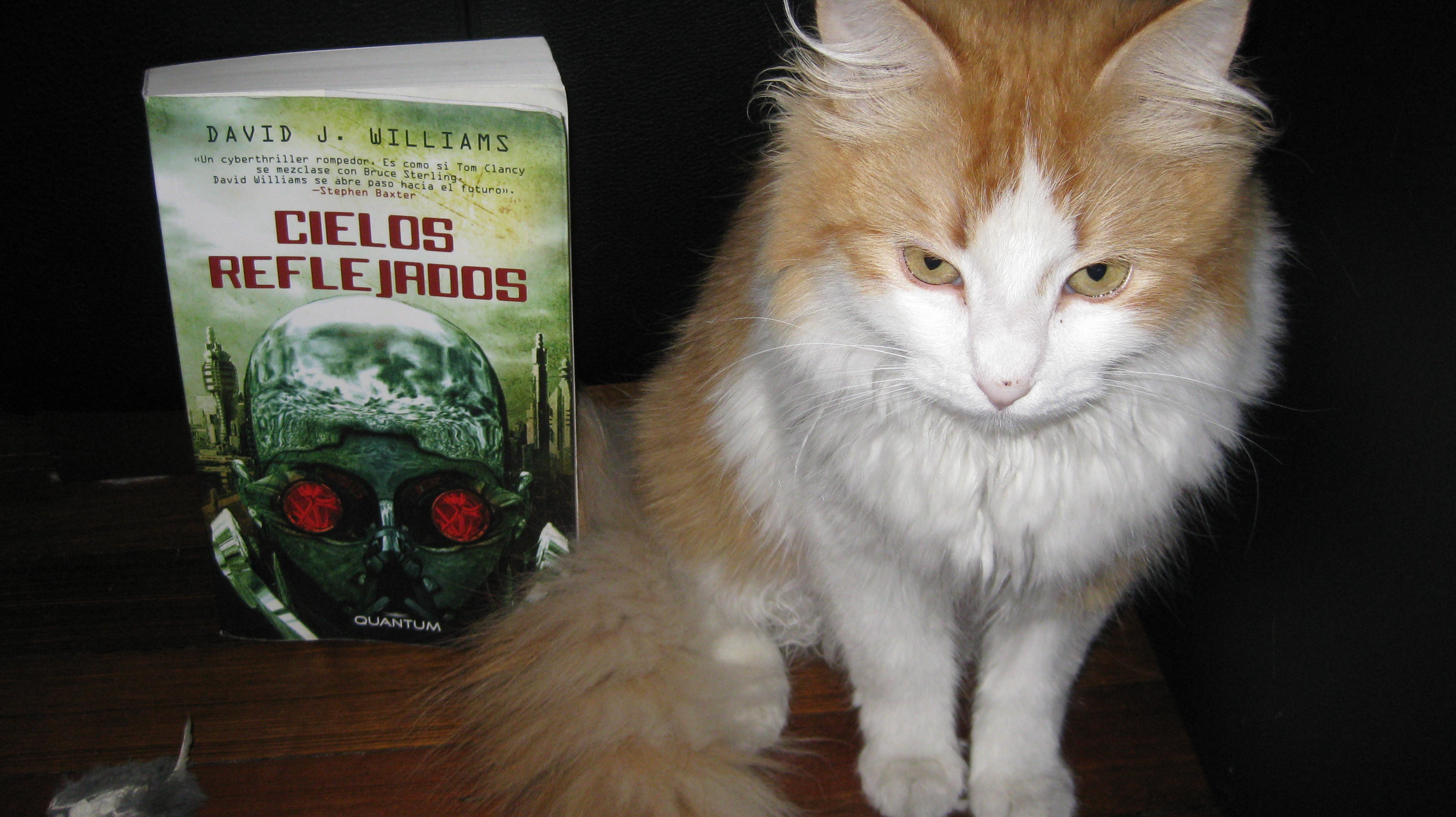
–The cat of the friend I’m staying with is possibly the largest I’ve ever seen (and none of it looks to be muscle).  It’s under the bed right now, and I fear it might have gotten stuck.

Ninja-Assassin looks like it’s going to be bad-ass, and it seems pretty clear that its star Rain can get laid at will. I felt sorry for the other folks on Joel Silver’s panel (like director James McTeigie and actress Naomie Harris), because literally the first ten audience questions were directed to Rain by fangirls who were almost quivering with lust. Me be jealous.

–The best way to ensure people show up for your book signing is to make the books free. Thanks to Bantam, I got to sign about a hundred giveaway copies of THE MIRRORED HEAVENS for folks, some of whom will read it and hail it as a revolutionary work of SF, some of whom will read it and hate it, some of whom won’t read it, and some of whom will throw it out when they open it and realize there’s no pictures.

See you tomorrow.

July/August schedule

Tuesday, July 22nd, 2008

The West beckons:

San Diego–ComicCon, July 24-26 (will be signing copies of THE MIRRORED HEAVENS at Bantam Spectra’s booth at 4 pm on July 24th)

San Francisco–Borderlands Books, July 27th: Reading/signing Sunday afternoon, at 3 p.m.

Orange County Science Fiction Club, July 30th: 7 p.m, Fullerton, CA.

Seattle–University Bookstore, July 31st: Reading/signing at 7 p.m.

Denver–WorldCon, August 6-10th: I’ll be appearing on the panels Underrated SF Movies (Saturday, 11:30), and Private Space Programs (Saturday, 1:00), as well as doing a signing on Friday at 1. Unfortunately the Weapons in Space panel got canceled, though that may be just as well, since it was scheduled for early Sunday morning, and might have been kinda ugly.

Kicking cyberpunk’s ass

Thursday, July 17th, 2008

SF Signal reviewed the book: they didn’t really like it (well, to be precise, they said it was a “decent read with some major flaws that keep it from reaching greatness.”) But hey, one of the things that every new author has to recognize is that (gasp) not everybody is gonna love your novel. Yet what really got my attention was this:

Stephen Baxter, on the back cover, calls Mirrored Heavens ‘a crackling cyberthriller.’ Well, if you’re looking for cyberpunk, you won’t find it here. True, the two-man teams consist of a Razor (hacker) and a Mech (muscle), with the Razor providing network backup and support for the Mech. However, just because the Razors can access the Zone (network) and work some heavy duty magic doesn’t make this book cyberpunk. Yes the world of this future is a dystopia, but the characters here aren’t from the bottom of society, fighting against the government or corporations, they are the government, and far from fighting for the little guy, they are fighting to save the status quo.

This is fascinating to me, all the more so as I totally disagree.  At its heart, I take cyberpunk to be about the interface of humans to technology in a world where the tech is so immersive that humans are (almost literally) inside that tech, and vice versa.  As to where it goes from there:  it’s true that the dominant strand of cyberpunk thus far has focused on the predicament of the “lone wolf” fighting against corporate interests.  But I have yet to see the Cyberpunk Rulebook that says this is a necessity in order to merit inclusion within the subgenre.

And even if you showed it to me, I’d throw it out the window and get back to my work.  Because I think this kind of literal “checkboxing” isn’t just intellectually lazy:  it’s proof that cyberpunk, like any genre that’s been around for a while, needs a good kick in the ass every once in a while to keep the circulation going.  In fact, it’s ironic that a genre that was founded on an ethos of rebellion should try to dictate rules about Just How Bad-Ass a Noir Hero You Need To Be in order to be included.  But consider this:  if cyberpunk is fundamentally about alienation (and I think it is) .  . . why assume that those who are charged with defending the status quo are any less conflicted or alienated than those who fight it?

Especially when it turns out that the status quo just ain’t what anyone thought it was.

Reading tonight/reappraising Star Wars: THE PHANTOM MENACE

Tuesday, July 15th, 2008

I’ll be reading at Flights of Fantasy Books in Albany, NY tonight at 7 p.m. If you’re local, stop on by!

And on an unrelated note: I was watching STAR WARS Episode One again last night, and realized something about it. Which is: the first ten minutes are pretty much perfect. The Jedi diplomatic mission, the double-cross, the frenetic pursuit through the corridors of the trade federation ship . . . that stuff ROCKS. In fact, the movie continues to rock until they invade the planet and we encounter Jar-Jar. I know a lot has been said about that guy, and believe me, I’m not going to offer any incredibly insightful revisionism re his role. You’ll find no new interpretations here. In fact, I’m a staunch traditionalist on this front:  because if I’m right about the first ten minutes of PHANTOM MENACE, then Jar-Jar didn’t just wreck the movie.  He wrecked an awesome movie.

Sigh.

MIRRORED HEAVENS reading in Albany tomorrow!

Monday, July 14th, 2008

I’ll be doing a signing/reading of THE MIRRORED HEAVENS at Flights of Fantasy Books, Albany, NY tomorrow, July 15th, at 7 p.m. The folks who run it seem really cool, and I’m looking forward to meeting them. If you’re in the area, stop on by, as it’s gonna be fun. Last time I read from the spaceplane hijack scene; this time, I think it might be the maglev train chase through the Atlantic Tunnels. We shall see. The suspense builds. . .

In the meantime, I’m taking today off to hang out with my friend Jerry, who escaped the NYC ratrace a few years ago so he could chill amidst the upstate greenery. We’re gonna do some canoeing (hopefully that’s not a code for some new type of designer drug that all the cool kids have gotten into), and kick back a little. Hope everybody enjoyed the weekend. Now I’m off to extend it just a little longer . .  .

The publishing gauntlet

Wednesday, July 9th, 2008

I’m guest-blogging over at Bantam Spectra’s Facebook page for the next few weeks. Spectra told me there’s a lot of aspiring authors over there, so I figured I’d start things off with a post about How To Get Your Novel Published. You can click HERE for the whole thing; it’s (obviously) all just my opinion—or rather, represents my potentially idiosyncratic experience in getting published—but I sure wish someone had told me something similar back in 2006 when I was first gearing up for a tilt at the publishing windmill. Perhaps there’s a way for me to email this back in time to that struggling, desperate fool who didn’t understand critical things like (a) the REAL solution to the “can’t get publisher without an agent/can’t get agent without a publisher” paradox, or (b) what all the query-letter advice books overlook, or (c) the actual key to success . .  .though I guess given how things turned out, it’s a bit of a moot point now. Fortunately.

But hey.  What are you still doing here anyway?  Go check out the post!

Weekend round-up

Monday, July 7th, 2008

The bad news first. Some punk(s) has/have stolen several laptops right out of Clarion West’s 08 residential house. Thanks to the generosity of the Seattle/Clarion West community, replacement laptops have been secured for the summer, but that still leaves students facing the need to ultimately buy new laptops (to say nothing of the mental stress incurred in losing critical files/data). If you’re able to donate or contribute in any way, contact Leslie or Neile at infoATClariontWestDOTorg.

On a happier note, I’ve sent in to Bantam “exclusive bonus material” for the mass-market paperback version of THE MIRRORED HEAVENS. The mass-market will thus represent the first time any excerpts from my glossary will have seen the light of day, but what I’m really excited about are the “character dossiers.” These consist of files on (a) the agents, (b) the handlers, and (c) the Inner Cabinet (i.e, the rulers of the United States):  they’re written from a senior Praetorian perspective, and they shed new (and, I think, interesting) light on the book’s events.  They also point the way toward the sequel, but that’s another story . . .

Space-Centric Warfare, Part Five: Underwater Combat

Friday, July 4th, 2008

(To start reading from the beginning of this essay, click HERE. And by the way, Happy 4th.)

Though the Eurasians possessed no equivalent to the Raft, their own navies didn’t lack for funding. This was in large part due to the fact that the most interesting thing about the ocean was, as ever, what was lurking beneath the surface. In fact, the seas were essentially the only place where mobile weapons/vehicles could be hidden from satellite surveillance. Such surveillance was far better than in the 20th century—when it had essentially been nonexistent—but it still remained far from perfect against a deep-running, stealthy submarine.

All the more so against a submarine capable of suddenly attaining “warp speed”: because, ultimately, the one factor above all else that guaranteed that naval items would be a priority item in the defense budgets was that the speed of 22nd century undersea warfare promised to render that of the previous century slow-motion—literally. Tapping the possibilities inherent in supercavitation technologies allowed the development of vessels that could reduce hydrodynamic drag by traveling inside superheated, self-generated bubbles of water vapor and gas—and that could thereby move at hundreds of kilometers per hour, irrevocably altering the pace at which undersea warfare would be conducted.

A critical byproduct of supercavitation was that it intensified the urgency of anti-submarine strategies, particularly in the vulnerable areas near the coast. Just as with geosynchronous orbit, technological/strategic realities drove a mutual understanding regarding the positioning of munitions here as well:  by the 2080s, the two powers had tacitly agreed to recognize the extension of territorial waters to four hundred kilometers out. Most admirals believed that even this was not enough, given the speed of hypersonic missiles and the reality of directed energy.  Accordingly, those four hundred kilometers were awash with underwater sensors, sea-bottom stations, mines, and anti-submarine submarines.  Destroyers cruised the surface and prowled around ocean-going platforms of varying size, while swarms of jet-copters patrolled the skies.

To be sure, littoral waters were an area where the U.S. (despite the positioning of the Rafts as forward attack platforms) had much more to lose than did the Eurasians, since so many of the large American launch pads were situated in relatively close proximity to the coasts.  The United States therefore poured tens of billions of dollars into its Atlantic and Pacific Walls, which extended as far south as the northern parts of South America.  Nor did Navy (and, eventually, NavCom) officers ever tire of arguing that these defense lines should be extended all the way to the Horn (a strategy that would mean absorbing the few neutral territories situated down there).  It could also be assumed (though no one ever admitted it) that both sides had positioned strongpoints at various places in the deep trenches across the world’s oceans, as these avenues represented logical points of concealment for approaching attack submarines.

In this regard, the most studied and speculated-upon undersea theater was that of the Arctic Ocean, across which the two superpowers directly faced each other at a relatively short distance.  The ice-packs may have been dwindling, but they were still much in evidence—and they would make it even more difficult for space-based and aerial recon platforms to intervene in the ever-shifting game played out by hunter and hunted in the most frigid of all waters.