Well, here we are five days out, and already some folks have been rash enough to weigh in with reviews. Library Journal kicks things off by calling THE MIRRORED HEAVENS “a powerful, rapid-fire SF adventure/intrigue story with echoes of cyberpunk . . . This stellar hard SF debut with hopes of sequels belongs in most SF collections.” They fail to specify the parameters that define those collections in which the book DOESN’T belong, but you’re not going to find me complaining. Nor will you even hear me carping about the “echoes of cyberpunk.” (Folks, there’s more than an echo in this book. But don’t take my word for it. Go ahead, try it and see.) At any rate, this review comes in after what’s been a bit of a deafening silence so far, so it’s greeted over here with no little relief.
Likewise with Graeme’s Fantasy Blogspot. I’ve been a fan of this gentleman for some time, so it’s a total honor to have him write stuff like “it’s a bit early to be picking my favorite sci-fi novel of the year, but I can say that [this] is definitely on the shortlist.” He does note that the plot gets maybe “a little too convoluted” (in my opinion there’s no such thing as “too”, but maybe that attitude is part of the problem), but he went on to say it nonetheless “kept me hooked right until the end.” After which he claimed I know how to write a “mean action scene” (guilty) and that I’ve put a great deal of thought into world-building. And he specifically cites “cityscapes that are gorgeously drawn (if menacing) with a real cyberpunk feel.” See, Library Journal? Cyberpunk: it’s more than an echo! Graeme sez so!
More to come as I get them. For now, over and out.
And suddenly, UAVs are everywhere. Let’s start with about ten blocks from where I’m writing this, over at the Smithsonian’s Air and Space Museum, where an exhibit has opened “celebrating unmanned flight technology.” The exhibit features UAVs from all four U.S. service branches—as well as sponsorship courtesy of General Atomics, proud parent of the Predator, the most famous of the UAVs out there (at least among the ones we know about). And indeed, the original Predator is on display: though you won’t see any of its Reaper successors, given that they’re running sorties over Baghdad, where they’ve got better things to do than impressing tourists and Appropriations Committee congressmen.
Yet what runs the risk of being overshadowed amidst this first-of-its-kind display is the extent to which other nations are getting in on the act. At present, UAVs represent yet one more attribute of the superiority of U.S. military hardware. That won’t change any time soon—the really sophisticated UAVs will sport the Stars N’ Stripes for the time being. But the ability to send an unmanned machine into the air to do useful things is a threshold that’s been crossed in many countries, and that’s likely to accelerate, given a wide range of recon and (at a more advanced level) combat uses. Though combat cuts both ways, of course . . . .case in point: last week’s downing of a Georgian UAV drone by a Russian MIG.
If you haven’t seen it already, the vid’s worth watching, all the way to the static as the missile takes out the drone. (The dry commentary of the Georgian defense minister is also pretty good.)But pyrotechnics aside, this is all about different thresholds of functionality at the end of the day. And as we see signs of a new, “poor man’s” generation of UAV emerge, we can expect the basic functionality to commoditize to the point where basically anyone can build one. And ultimately, anyone will. Expect the next round of insurgent warfare to feature UAVs on both sides.
Arthur C. Clarke lived to see the twenty-first century of which he had written so often. He might have hoped that things would be a little further along by now, but the man’s indefatigable optimism allowed him to take the long view. Which, after all, is what he was best at. He was a scientist who became a science fiction writer to keep pace with his own ideas—ideas that propelled him to a level of mainstream celebrity beyond the reach of any writer in the field besides H.G. Wells, in spite of (or perhaps because of) his persistent refusal to compromise his vision. One envisions the conversation now (through a wormhole in space-time, perhaps, reaching all those years back to the dingy corridors of the 1960s Chelsea?): “no sound! space is silent! let it speak for itself!” He was fortunate enough to find a director who would listen—and who had genius to match his own. Had an observer of 1970 been asked to select what SF author would dominate the box office across the next few decades, the answer would have been obvious.
And wrong. (Then again, no one would have seen PKD coming . . . ) But Clarke understood that history has a way of surprising. Perhaps that was why he seemed so unphased as those responsible for manned space exploration so completely lost the plot. After all, his original prediction that man would reach the Moon by 2000 was derided when he made it in the 1940s. It would have taken someone far more cynical than Clarke to predict in the 1970s that thirty years later we’d still be struggling to get back to Luna. And by the time 2001 really rolled around, we all knew it was a metaphor anyway: an attempt to sketch out the broad contours of future rather than link specific milestones to particular dates.
And what about those aliens? Were they a metaphor too? Hardly. They were, in fact, Clarke’s only regret. His 90th birthday greetings expressed sorrow that he wouldn’t live to see our species make first contact. For him, E.T.s weren’t just an affirmation that we aren’t alone in the universe: they were the cornerstone of his belief in Man Transcendent. Story after story involved humanity struggling to raise itself to the next stage of evolution under the dispassionate gaze of cosmic overminds (or, rather, minds that had already made the journey). Clarke claimed not to be a religious man, but it seems clear enough that he did have a religion of a sort—or, more accurately, that he hoped to turn the keys of religion over to science. We cannot say that he succeeded. But he may have laid the groundwork.
Making him, in the final analysis, almost impossible to judge. As Zhou En-lai once said when asked to evaluate the significance of the French Revolution: “it’s too soon to tell.” So it is with Clarke. His recognition of the significance of the geostationary orbit would have guaranteed him a place in history. But what would have been the pinnacle of any other man’s career became merely the first achievement of Clarke’s. And one senses that the extent to which he was embraced by the zeitgeist of the Apollo Era might be the harbinger of a more lasting verdict: that the public was right to consider this man the greatest of the SF authors. A question that can’t be settled here. But it’s worth noting that in stark contrast to so many of his contemporaries (including his fellow members of the Big Three, Asimov and Heinlein), the heart of Clarke’s philosophy was the proposition that mankind was unlikely to reach the stars unchanged. He reached them earlier this week. We who remain dwell in his shadow. RIP.
Another Russian plane buzzed the Nimitz earlier this week—the second such incident in a month. As Pavel Podrig noted, this one wasn’t actually a Tu-95 bomber; it was a naval recon aircraft (Tu-142), with an almost identical airframe as the Tu-95 (“Bear”). But the end result’s the same: heightened tensions. And don’t let the propellers on these things fool you. The Tu-95 is the only turboprop strategic bomber in existence; it’s still fully capable of flattening cities. (In fact, it was a Tu-95 that dropped the largest nuclear device ever detonated, back in the early 60s. Yeah, the early 60s. This thing’s old. Hey, so is the B-52.)
To set all this within the larger context: last year the Russian navy and air force resumed their Cold War patrol routes. Russian bombers routinely conduct exercises over the North Pole nowadays, and have the range to keep going if they wanted to. This is classic sabre-rattling, and reflects the extent to which Russia feels like it has to assert itself against U.S. encroachments—in particular, the plans to base missile shield components in Poland and the Czech Republic. Also, the goal of domestic consumption shouldn’t be minimized: Putin gets a bad rap in the West, but in Russia he’s extremely popular, all the more so as he’s seen as attempting to reverse the humiliations that Russia suffered in the 90s. So announcements in Moscow of carriers being subjected to faux attack runs play pretty well.
Of course, were this actually a hostile attack, the recon craft would be a hell of a lot higher, and they’d be accompanied by (and directing) swarms of bombers in from every direction, all of them with one thing on their mind: becoming the first pilots to bag a U.S. carrier since the Second World War. But let’s put things in perspective: Russia’s current military resurgence still leaves them well below the superpower status of the U.S.S.R. However, the Russians are clearly sending the message that they intend to claw back some lost ground, and we can thus expect more such incidents in the near future.
Been a lot of talk this week in the blogosphere regarding the New Face of Killer Robots, thanks to a well-time PR land-grab by a robotics dude at the University of Sheffield, who warns us that it’s only a matter of time before terrorists start deploying robots against us. This overstates the problem. We’re a long, LONG way from the days of a robot being cheaper than a human. Just because it’s a jihad doesn’t mean the laws of economics don’t still hold sway. “Let me see, I can either build a super-expensive mobile robot or I can recruit some teenage fanatic. Hmm. I JUST CAN’T DECIDE.”
Still, hyperbole aside, the underlying point being raised here is a good one, particularly with UAVs buzzing all over Afghanistan and similar ground-vehicles now under development. Part of the problem in calling for an agreement to “limit” such weapons or determine rules for them is that right now the U.S. is the only nation that is anywhere near close to tapping the full range of operational potential that such assets afford. Russia fielded some recon units in Chechnya, but they’re a long way from the general’s wet dream of being able to watch your enemies on a screen while you sit back, open up a sixpack, and hit the KILL button. As with space weapons, this is an area in which the U.S. maintains a decisive advantage, and they’re unlikely to be held back by calls for international agreements from those who can only wish they had this kind of hardware to fuck around with.
But the key variable in all this is the level of sophistication of the robot brain that’s targeting that terrorist strongpoint on the next street corner/deciding that maybe those kids hanging around on that corner are actually just innocent bystanders. Even soldiers have trouble with this (as so many headlines from Iraq underscore), and robots are a long way from getting to this kind of threshold. Fast-foward enough years/tech development, and the questions become very interesting though. To be continued . . .
Lest the Navy (or anyone else) get too excited over its demonstration of missile defense technology, here’s a reality check:
If the weather had sucked, they would have delayed it.
And they almost did. But fortunately the seas weren’t too rough come launchtime. But folks, this is ballistic missile defense that we’re talking about here. Missiles don’t get fired when the weather’s great. They get fired when someone hits the trigger. Which is why ground-based defenses like the ones in Alaska (and eventually in Eastern Europe, depending on what the Russians have to say) are ultimately more critical than ships.
It’s also why as missile defense continues to gain momentum, sooner or later its advocates will be renewing their call for space-based weaponry. Ultimately, it’s hard to have a serious missile shield without that. In fact, it’s sufficiently hard that missile defense is likely to become a stalking horse (some would say a trojan horse) for space weaponization. Meaning that when the time comes, such weaponization will be portrayed as a necessary step to realize the full value of investments we’ve already made, rather than the start of a new arms race.
A B2 bomber has crashed on takeoff in Guam. The two pilots bailed out in time.
We’ve noticed some confusion out there in the blogosphere regarding this and the last high-profile Stealth incident, the Kosovo shootdown in 1999, with some folks thinking these were the same type of aircraft. They weren’t. The one that got shot down by Serbia in 1999 was the F-117 Stealth fighter/ground attack aircraft. And apparently the Russians got a good look at the wreckage. They’re now busily working on their own: one more component of their post-Cold War military resurgence.
Last night the U.S. bagged its first satellite since 1985. The debris is still up there, but the political fallout is just beginning. Three things seem clear enough at this point.
#1: No Ifs, Ands, or Buts, This Was an Anti-Satellite/Anti-Missile Test: The claim that we had to blast this thing out of the sky due to the risk of hydrazine spraying all over some schoolyard was bullshit, pure and simple. This was an absolutely golden opportunity to show off some tech that’s already proven it can do the job: the SM-3 missile has been tested successfully before against incoming dummy warheads. Only this time it nailed a satellite (albeit at a slightly higher altitude). Proving that national missile defense can do more than just bag missiles . . . .
#2: It Was Also a Message: China and Russia introduced new text for a treaty banning space weapons earlier this month. This was the U.S. answer.
#3: With More Than One Audience: National missile defense (aka “Son of Star Wars”) has prospered under eight years of Bush II. It represents a fairly significant component of the military-industrial complex at this point, and its champions are understandably concerned about budget axes, particularly as the nation sails into ever choppier economic waters. While the sat shootdown would never have been greenlighted had the U.S. leaders not wanted to send a “diplomatic” message (per #2), there were a lot of people at the Pentagon licking their chops at the prospect of getting to demonstrate in the most public way possible just what they’ve done with all the money they’ve been given. One more reason why you can be pretty sure they didn’t think they’d miss.
The revolution in military strategy that the arming of the heavens heralded extended to every arena of warfare. By the 2020s, it was already accepted as axiomatic that whoever controlled space would control the world. But the thousandfold nuances and corollaries to this basic postulate took some time to work out—and left a myriad questions in their wake. Certainly, it was recognized fairly early on that the ability to project power from space onto the ground rendered the heartlands of the major powers more vulnerable to swift attack than ever before. While in the 20th century satellites stood by to give notice of ballistic missile launch, and fighter-jets patrolled those areas through which bombers would have to pass, now space-based munitions would be able to rain destruction down on any point with little or no warning. All the more so as many of those weapons would be traveling at the speed-of-light, since directed energy weapons attained maturity well before the middle of the twenty-first century.
Consequently, as the Second Cold War intensified, the two superpowers redirected resources toward a defense in depth around the (extensive) geographies under their direct control. In the new paradigm, ground- and aircraft-based lasers and missiles would join forces with their counterparts in space to respond to attacks that hurtled in from beyond the bounds of air—and to grapple directly with the sources of those attacks. One secondary outcome of this stance was that it rendered Europe’s efforts to ensure that it would not be the cauldron of a future conflict tolerable to both superpowers–the margin of advantage that would have been provided through European bases was, ultimately, negligible. Yet it should be noted that most of the neutral powers did not fare as well as the Euro Magnates. Many of them—particularly those that occupied valuable equatorial territory (the ideal point for launch-sites)—found themselves absorbed within the superpowers’ defense grids so that the ever-growing launch architectures could maximize their ground-to-space capacity.
From the perspective of civilians dwelling within the U.S. or the Coalition, however, the most significant implication of the mass deployment of space-based munitions was the end of the era of mutual assured destruction (MAD). For, although it was true that the distance that nuclear-tipped missiles had to travel was now far shorter, the rise of space-based defense systems and speed-of-light weaponry meant that any missile could in theory be stopped. In fact, it was highly likely that any one missile would be stopped. This in turn resulted in the targeting of both nuclear and conventional warheads away from civilian sites and toward military ones; to do otherwise would have been to waste weapons that could have been used on targets with counterforce capabilities.
Furthermore, the actual importance of nuclear weapons diminished with the rise of hyper-precise firepower. There was, after all, little sense in using a politically problematic nuke when a powerful conventional device or a directed energy broadside would do just as well. Yet the sweeping aside of the MAD era left at least some military planners feeling somewhat nostalgic: whereas a city-busting nuclear exchange had always been at once both the standard wargaming conclusion in a clash between the superpowers of bygone days—as well as the central factor that made such a war less likely—now that certainty was gone. Was conflict more probable? If so, to what extent had that probability increased? How might such a confrontation play out? And how might it end? These were questions that persisted even after the Zurich Treaty . . .
Welcome to the year 2110. Within these pages you'll find background material on the acclaimed Autumn Rain trilogy, as well as commentary regarding contemporary cultural and geopolitical issues.



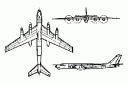 ll this within the larger context: last year the Russian navy and air force resumed their Cold War patrol routes. Russian bombers routinely conduct exercises over the North Pole nowadays, and have the range to keep going if they wanted to. This is classic sabre-rattling, and reflects the extent to which Russia feels like it has to assert itself against U.S. encroachments—in particular, the plans to base missile shield components in Poland and the Czech Republic. Also, the goal of domestic consumption shouldn’t be minimized: Putin gets a bad rap in the West, but in Russia he’s extremely popular, all the more so as he’s seen as attempting to reverse the humiliations that Russia suffered in the 90s. So announcements in Moscow of carriers being subjected to faux attack runs play pretty well.