The world’s most elite Crackberry

January 22nd, 2009

Thanks to the NSA, Obama gets to keep his Blackberry, which will be “super-encrypted” to allow him to continue to have private conversations. Obviously with the Chinese (and, presumably, a lot of others) doing their utmost to hack the White House (like they did last year), there’s a lot at stake here, but future presidents are likely to follow in Obama’s footsteps all the same. We’ve still got a ways to go to the world of MIRRORED HEAVENS, where the software implanted in the president’s head contains all the firing/missile launch codes, thereby serving as the future equivalent of today’s legendary nuclear football (aka “the button”), but the use of technology at the apex of national decision-making will be increasingly redefined.  In the meantime, we can only assume that the executive branch has done its utmost to ensure that no one at the NSA pulls any stunts: an additional level of security is that much better access if you’ve got the back-door….

Of course, the other reason why advisers were so reluctant to let Obama have his way is the paper-trail issue. If Bush and Cheney had carried those little devices, they’d be in even deeper shit than they already are. Could it be that Obama plans on committing no crimes in office? I guess we might have the audacity to hope.

Inaugural highlights

January 21st, 2009

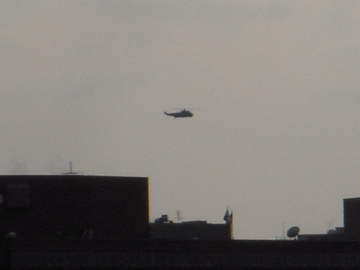
-Watching Bush’s helicopter take off. My friend and I ran to my apartment roof as the chopper lifted off the ground, and sure enough, there it was buzzing along the skyline. She snapped the attached picture.

-Seeing Cheney in that #$# wheelchair.

-Hearing endless analysis about that flubbed oath.

-Listening to Rick Warren for the first time and having my (admittedly not incredibly refined) Gaydar totally set off.  Is this why he’s so #$# homophobic?

-Listening to Obama’s speech. It felt like it was probably shopped around too many editors to really strike home with any chisel-it-in-marble-prose, but it wasn’t just the bunch of platitudes that most inaugural addresses are, and was easily good enough to encompass the national dilemma(s) and point the way forward. Best line was probably the bit about “we reject as false that we have to choose between our ideals and our safety.”

-Listening to the last words of the Benediction.  Fuck, did Lowery OWN that podium.

-Watching the parade. Speaking on CNN, David Gergen said he breathed a sigh of relief when Obama stepped back inside the mega-limo after walking part of the way down Pennsylvania Avenue.  So did I.

January 20th, 2009

January 20th, 2009

Let it be said by our children’s children that when we were tested we refused to let this journey end, that we did not turn back nor did we falter; and with eyes fixed on the horizon and God’s grace upon us, we carried forth that great gift of freedom and delivered it safely to future generations.

David Coe interview

January 19th, 2009

24 hours to go until inauguration, and the last post of the Bush presidency goes to fellow scribe David Coe. I don’t think he planned it that way, but someone had to do it.  (Interview questions are from the SFnovelists website.)

David B. Coe (www.davidbcoe.com) is the Crawford Award-winning author of ten fantasy novels and several short stories. A refugee from academia, David has a Ph.D. in history and has taught at the university level. In a life prior to that prior life, he was a political consultant. The Horsemen’s Gambit is the second book in his Blood of the Southlands trilogy. It is to be published on January 20, 2009, which is good because there’s nothing else of importance happening that day to draw attention away from the book’s release….

Q) Can you tell us a bit about The Horsemen’s Gambit and the Blood of the Southlands series?

DBC) Blood of the Southlands begins with The Sorcerers’ Plague as a sort of medieval medical thriller. An old woman named Lici has set out to avenge a injury done her decades before by conjuring a plague. Before long though, the plague spirals far beyond her control, and in The Horsemen’s Gambit, the damage done by the plague to the Qirsi, the sorcerers of the Southlands, convinces their enemies, the Eandi, to attack Qirsi lands in the hopes of winning back territory lost during the Blood Wars. Along the way there’s political intrigue, some romance, and a web of personal interactions tinged with all this ethnic baggage.

Those are the basic plot points. In a larger sense this series, like my five-book Winds of the Forelands sequence [Rules of Ascension, Seeds of Betrayal, Bonds of Vengeance, Shapers of Darkness, Weavers of War], which is set in the same world, deals with issues of race, ethnic identity, and prejudice. My characters, particularly those who seek to control the chaos unleashed by Lici’s curse, are constantly fighting against the destructive power of ancient hatreds. Ultimately this newest book — like those that came before it and the one that remains — is about overcoming history and transcending bigotry.

Q) Race, prejudice, ethnic identity — That all sounds pretty familiar. Is Blood of the Southlands set in a created world or our own?

DBC) It’s definitely a created world, but as with all my work, Blood of the Southlands touches on issues of great importance in what we call, for lack of a better term, the “real” world. My LonTobyn series [Children of Amarid, The Outlanders, Eagle-Sage] touched on ecological themes. Winds of the Forelands and Blood of the Southlands deal with race. I have another project that I’m working on that focuses on drug addiction. I write books that I hope will entertain. I strive to make them fun — as I said, there’s lots of action and intrigue, romance and even humor. But they also deal with serious issues that resonate with social concerns in our own lives. I do this because I find it more interesting to write books that grapple with big questions. And if some of my readers come away from the books thinking about race or ecology or substance issues in a new way, all the better.

Q) What is it about fantasy that attracts you?

DBC) Well, in part I’m drawn to fantasy precisely because I can create worlds that then serve as mirrors for our own world. Admittedly, these are imperfect mirrors, but they’re mirrors nevertheless. I can make the Forelands/Southlands universe and create racial tensions that are complex and compelling, and yet different enough from the racial problems in our own world that no one will be offended by the books. Speculative fiction offers us a unique opportunity to look at ourselves through a lens that both distorts and magnifies. The distortions allow us to distance ourselves and perhaps examine an emotionally fraught issue without so much emotional heat. The magnification can make us see things that we might otherwise miss.

I’m also drawn to fantasy, as well as science fiction, and dark fantasy, and horror, and all the other subgenres in our field, for the simple reason that they’re so much fun to read. I love magic. As a friend of mine wrote elsewhere just the other day, I believe in magic on some level. And being able to write magic into the lives of my characters, giving them the ability to shape their world in ways that I can only dream of doing myself, is enormously entertaining.

Q) Why did you decide to make Besh, one of the protagonists of Blood of the Southlands, an old man?

DBC) Well, let me start by saying that I’m not certain I “make” any of my characters, any more than I’m certain that I control their actions. My characters present themselves to me. They clamor for my attention, and when I finally turn my mind’s eye on any one of them, he or she tells me his or her story. When I first started conceiving of the Blood of the Southlands trilogy, Besh was the first character I met. I didn’t know at the time why it was important that he tell so much of the story, but I trusted him and also my instincts as a writer, which told me that he was crucial to the entire series. I think I was drawn to him, at least in part, because he was so different from other protagonists I’d written and other heroes I’d encountered as a reader. Yes, he’s old. He’s also got that stubborn sense of “I know myself, and I know the world, and by God you’re going to listen to me,” that we sometimes find in our elderly friends. He’s not particularly strong physically, and he wields little influence or political power. But he’s clever and wise and uncommonly brave. He has a profound moral sense and is intensely loyal to his people and his family. Over the course of writing the three books of the Southlands series he became just about my favorite of all the characters I’ve ever written.

Q) You’ve been a historian, you’ve worked in politics — it seems you came to writing relatively late in life. How did it happen?

DBC) I suppose I did come to it a bit late, but the irony is that I’ve wanted to be a writer since I was a kid. I wrote and illustrated my first books in first and second grade — and given the quality of my illustrations, it’s a good thing I can write. I went to college with every intention of majoring in creative writing, but got sidetracked by concerns with practical considerations, like making a living. I tried political consulting, but found it disillusioning. So I went to grad school, got my degree in history, and applied for a bunch of teaching positions. But the summer after I completed my degree I found myself with lots of free time on my hands. My grad work was done, but the academic jobs hadn’t been listed yet. And my wife said to me, “You know, since the day we met you’ve been talking about writing a book. You have some time now. Why don’t you spend the summer writing?”

I did, and by the end of the summer I had several short stories written (none of them has ever seen the light of day, and none of them ever will) as well as the first five chapters of what would eventually be Children of Amarid, my first novel. A friend of mine agreed to act as my agent and he shopped the book around while I applied for teaching jobs. I got the perfect academic job offer — teaching environmental history in Colorado — and my first nibble from Tor Books within 24 hours of each other. I chose writing and have never looked back.

Q) Aside from writing, what do you do for fun?

DBC) Well, I’m a husband and a dad, which are the two things that mean the most to me. My daughters are 13 and 9, and a lot of my non-work time is taken up with stuff I do for or with them. I’ve been a Soccer Dad, a Swim Dad, a Dance Dad, a Music Dad, and a Theater Dad. And because my wife is a full-time college professor, I do most of the grocery shopping, a fair amount of laundry and house stuff, etc. In addition, I’m active in my community — I run a local food cooperative, I’m on the parents’ council of my older daughter’s school, and I’m on the town council here in our little village. But when I’m not doing any of that I have quite a few outside interests. I like to hike and birdwatch. I’m a dedicated amateur photographer and actually had my first one-man exhibit in 2008. Nature and landscape photography mostly. I play guitar and sing — folk, rock, a bit of bluegrass. I listen to music all the time. I look at butterflies and run a local butterfly census here in my home town. I’m a bit of a political junkie, and I’m confident that my professional output will be greater in 2009 than it was last year, simply because I won’t be checking political web sites every 3 minutes.

Q) What’s a typical day like for you?

DBC) A typical day? I’m not sure there’s any such thing — did I mention that I’m the father of a teenager? My routine looks something like this: We’re up at 6:30 am. I make lunch for my younger daughter and do what I can to get the girls moving. After my wife and I get the girls to their schools, I go to the gym for an hour or so. Exercise is crucial for me; without my morning workout I’m not sure I could function. I get back, have a light breakfast, check my email, and begin the day’s writing. I shoot for 6-8 manuscript pages a day, which translates to about 1500-2000 words. I’m not a particularly fast writer, but if I can write 35 to 40 pages a week, that’s a book every 6 months or so, which isn’t too bad a pace. I might have to pick up one of the girls from school or take them to dance or sports practice, but I can usually get back to work for a while longer. I knock off around 5:00 or 5:30 and the rest of the evening is family time. I don’t work on weekends, and I don’t work many nights. I work at home, so it would be very easy to be sucked into working all the time. To prevent this, I set strict boundaries. I have work time and family time. I’d probably get more written if I was less strict about this, but that’s a choice I’m comfortable making.

Q) What are you working on now?

DBC) The third and final Blood of the Southlands book is finished and handed in to my editor (it’s scheduled for release in January 2010). I’ll have revisions to do eventually, but for now I’m working on a new project that is completely separate from anything I’ve done before. It’s alternate world fantasy set in a place that’s roughly analogous to early Renaissance Europe. There’s a magical element and each book is a stand alone mystery with recurring characters. I don’t generally like to talk too much about works in progress until I’m further along than I am with this series. Suffice it to say that I’m very excited about this one. I hope to see the first book in print sometime in 2010.

David B. Coe’s personal website can be found at www.davidbcoe.com. He blogs with some regularity on both LiveJournal and WordPress, and he is part of the MagicalWords.Net writing blog with fellow fantasy authors Faith Hunter, Misty Massey, and C.E. Murphy. The Horsemen’s Gambit, book II of his Blood of the Southlands trilogy, can be purchased through Amazon.com. (Release date: January 20, 2009)

This writing life

January 16th, 2009

. . . is an ongoing series that John Ottinger over at Grasping for the Wind created and runs. As I mentioned, he reviewed MIRRORED HEAVENS earlier this week; he also was kind enough to invite me to appear on This Writing Life, and here I am! Tune in to find out all about my approach to space war, as well as the Autumn Rain/Al-Qaeda analogy, and a couple of other random tidbits too.  Thanks a ton, John! And of course the mass-market is available at Amazon and other fine bookstores. . . featuring new stuff like secret agent dossiers and all sorts of other skulduggery . . .

Why MIRRORED HEAVENS isn’t a bestseller (yet)

January 15th, 2009

Ok, so the book’s done well, and sales are generally strong—but MIRRORED HEAVENS remains a long way from battling its way out of the midlist. And I have to rationally grapple with this fact, because I need to figure out how to market the upcoming mass-market (not to mention the rest of the series). I’ll have a post shortly on stuff I did to market the trade paperback (released last summer), kinda like what my pal David Edelman did here. But in the meantime, I need to think deep.

I need to STRATEGIZE.

And in the hopes this will be helpful to others, I intend to be totally transparent about this.

And here’s what I’ve noticed, going back over the negative reviews (incredibly, there were some!).  You’ve got some people who say the book is just pure “combat porn”, with “little to no plot”, and then some people who say the plot was too complex, and they didn’t understand it.  Clearly, these directly contradict each other, which I find fascinating, and which leads me to believe that I have a larger challenge.  The core military SF audience at whom Bantam aimed the book has yet to entirely embrace MIRRORED HEAVENS; I suspect this is partially because it’s not as Manichean as that audience is used to (there’s no clear line between good guys and bad guys), and also because some of them might be getting lost in the thicket of unfolding conspiracies (because the book is in many ways a spy thriller).  At the same time, a lot of folks in the non-mil SF world haven’t looked past the shoot-outs, I suspect, and have been quick to dismiss it as just another kill-crazy action-fest.

So where does that leave me?  It leaves me all the more resolved to come up with a marketing strategy that will find a way to crack the lucrative n’ large military SF market, while simultaneously positioning MIRRORED HEAVENS for a breakout into the mainstream/Tom Clancy audiences.  Hell, Stephen Baxter himself invoked Clancy’s name in describing the book, and my agent sold it as LeCarre on SF crack, so there’s gotta be a way to crack this code. More on this later—

Latest reviews of MIRRORED HEAVENS

January 14th, 2009

First the good news. From John Ottinger of Grasping for the Wind’s review of MIRRORED HEAVENS: “Very few books have ever lived up to overused description of a “non-stop thrill ride”. The Mirrored Heavens is one of those few.” He goes on to say that its “vision of a dark and terrible political future and constant and significant plot twists make this novel a book you could read twice, each time with a wholly new perspective.”  I particularly appreciated his insight that in many ways the book’s more of a spy thriller than a traditional SF read; of special note is his discussion about whether it veers closer to James Bond or Jason Bourne (in the course of which he becomes the first reviewer to spot the underwater volcano homage, but that’s worth a whole ‘nother post. . .)

With a review like that, you know the karmic balance has to be evened up somewhere; credit here goes to Tia Nevitt at Fantasy Debut, who notes that the book is meant to be a “can’t put it down thriller” but that it took her months and months to read, so that’s clearly not what it is.  She also finds my editor’s favorite character, Linehan, to be “repugnant”, which I’m guessing probably has something to do with his penchant for delivering one-liners while committing acts of mass-murder. And then the inimitable Claire Haskell is compared to R2D2, which I gotta admit I’m still scratching my head over.  But hey, Tia, as long as you don’t invoke the Star Wars Xmas Special, I think we can still be friends.

Anyway, never mind the critics:  some will like it, some will hate it, but only YOU can decide.  Did I mention the mass-market is available HERE?

Writing process, part deux

January 13th, 2009

My post of last week on the writing process generated some follow-up questions; one of them centered on how much editing occurred to MIRRORED HEAVENS. Well, I was lucky to have an activist editor; I hear a lot of stories these days about how editors have hardly any time/bandwidth for editing, but I was fortunate in that Juliet Ulman of Bantam Spectra was nothing short of spectacular. There were two principal fixes she suggested to MIRRORED HEAVENS.

1.  Front-load the exposition. Frankly, I made the reverse of the mistake that many first-time writers make.  Wanting to avoid stuff like “as you know, Bob, the United States has been locked in a second cold war with the Eurasian Coalition for several decades, which has pretty much completely militarized America and created something that in name is a republic but in practice is essentially a military dictatorship in which the president (who we colloquially call “the Throne”) is supported by an Inner Cabinet composed of the heads of the various military commands who incessantly scheme/maneuver for power, and oh by the way, there’s lots of secret agents, and the ones who hack the zone are called razors, and the ones who kick down doors are called mechs, and by the way, the handlers mess with their memories, and the U.S. has occupied Latin America because space has been weaponized and equatorial launch real-estate is at a premium and did I mention–“. . well, I think you get the point. A novice would have stuck that in there; a novice like me who thought he was being clever would toss a few clues in there, but nowhere near enough, and the reader would be going WTF. Though my example above is more than a little exaggerated, striking that balance is tougher than it looks. But Juliet helped me to develop a # of smarter ways to do the exposition so that the necessary information is front-loaded (an obvious example:  put the Treaty of Zurich at the very front of the book).

And I’ve got a lot more to say on this, and I haven’t even got to Juliet’s other major change/feedback on the original manuscript—but it’s now a quarter to eleven, and the manuscript to book three is calling. . . . feed me. . . .feed me . . .  (in which respect it resembles my cat, who I might add has been itching to make an appearance in this blog for some time, and is unlikely to be denied for much longer.) More later.

Project Shadow HQ

January 9th, 2009

Dashpunk.com has been an integral part of online fandom for a decade now; late to the party as ever, I’m just getting introduced to them. They’ve just released a new manifesto to articulate their goals and beliefs; particularly interesting is their approach to copyright issues—an attempt to redefine the current IP rights debate within a larger context.

What’s also of interest, though, is the network they’ve built up at Project Shadow: HQ.  I’ve signed up, and am liking what I see: a dedicated group of folks talking passionately about the culture they love.  Plus there’s lots of cool videos too, including the (gasp) missing Star Wars rap archives—and it looks like somebody there is a metal fan too, as there’s more than a little Roadrunner concert footage. I’ve always argued that science fiction and heavy metal have something in common; maybe now I’ll be more than just a voice in the wilderness. . .

S.C. Butler

January 8th, 2009

The last of the January interviews: esteemed colleague Sam Butler, and fellow refugee from the corporate galleys . . . enjoy . . .

S.C. Butler is a former Wall Street bond trader who always preferred Middle-earth to the Chicago Board of Trade. Currently he lives in Brooklyn with his wife and a whippet. His website is www.valingstoneways.com.

1) What was your inspiration for writing [the book]? Queen Ferris is the second book in my Stoneways trilogy, which includes Reiffen’s Choice, and the third book, The Magicians’ Daughter, due out in April. The trilogy’s name says it all. I always liked Dwarves more than Elves, so I decided to write a book that way. With caves.

2) Who are your favorite authors now and when you were growing up? My favorite authors are Heinlein, Trollope, Tolkien, Lewis, Austen, Flaubert, Van Vogt, Vonnegut, Niven…

3) What is it about fantasy/science fiction that attracts you? Fantasy and science fiction interest me for different reasons. I read fantasy for the story and the characters – it’s not that much different from why I read any sort of book. Science fiction is different, however. Science fiction I read for cool ideas and a sense of Wow!.

4) Why did you decide to make Reiffen a Mage? Because the Stoneways trilogy is a story about power, and what’s more powerful, in any tradition and at any time, than a magician?

5) What sort of research did you do to write this book? Since it’s a fantasy, I did very little research. I checked out a few technologies to see if they were appropriate to the level of some of the cultures – in Queen Ferris, different cultures have different technological levels. The Dwarves, for example, have gas filled airships for traveling beneath the bottom of the world. The humans don’t.

6) Reiffen and his friends and love maple candy. Is that your favorite too? Nope. Just syrup on waffles.

7)  What are you writing now? A story in which one of the main characters from Queen Ferris comes to our world. The working title is Avender in America.

8) Did you always want to write? Or did you stumble into it? I always wanted to write. My earliest juvenilia dates back to when I was about ten years old. (Boy, is that stuff awful.) But it took me a long time to sell anything. 28 years from my first submission to my first sale. Of course, that will happen when you only write novels and get busy with a job and family. The job and my family were always my first priority.

9) What does a typical writing day look like for you? How long do you write, that sort of thing? My typical writing day depends on what part of the wip I’m working on. If it’s rough draft time, I try to write a minimum of 1200 words a day, which can take anything from two to ten hours, depending on my mood, how well I’ve imagined the scene, or whether I’ve burned myself out writing too much the day before. Rewrites, however, tend to be more predictably productive, running about four to six hours of work. I find writing to be exhausting.

10) Where do you write? At home at my desk, on my laptop, with anything from punk to classical on my boom box. However I get many of my ideas while taking long walks, and often write a book’s songs and poetry while walking as well.

11) What is easiest/hardest for you as a writer? It’s all hard. The only easy part is being done.

12) What is the purpose of fantasy/science fiction, if any? In my opinion, it’s the same as any other fiction: for readers to enjoy. Readers can enjoy books in many ways, from the cerebral and intellectual to the escapist and just plain fun. The point is in the enjoyment.
Both Reiffen’s Choice and Queen Ferris are available in hardcover and mass market paperback from Tor books. You can find them at most bookstores specializing in spec fic, or at Amazon and Barnes & Noble.